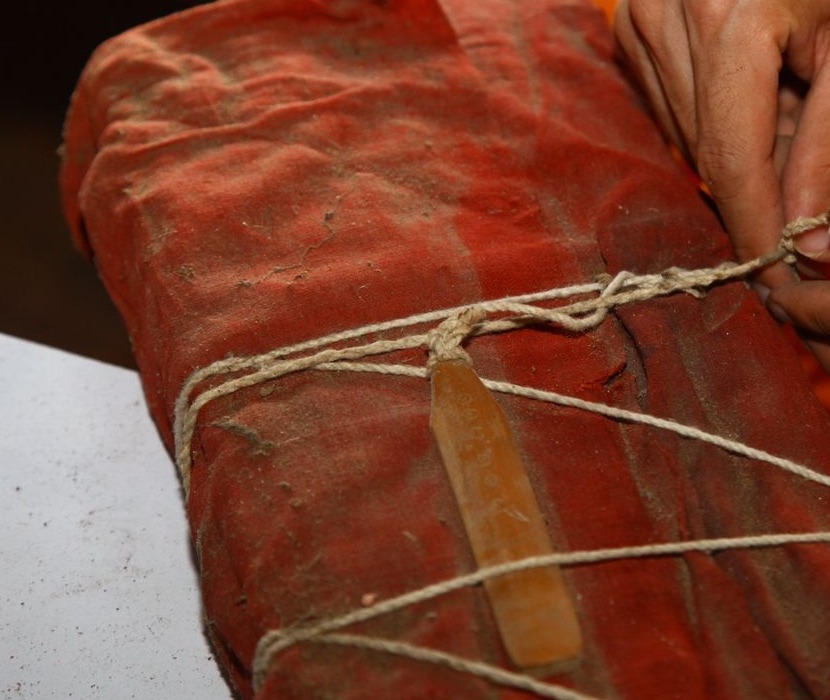
“The largest critical-edition program in the world for one of India's own classical languages is currently coordinated from Thailand because no comparable Indian-led program exists.”
— Dhammachai Tipiṭaka Project, India coordination brief
English readers have it. Chinese readers have it. Japanese readers have it. The eighty-three million Marathi speakers of India — heirs of Pāli as a language born on Indian soil — do not.
The classical Pāli corpus across the world's reading languages, May 2026
The Pāli Tipiṭaka — the largest single body of classical Pāli literature, comprising civic-legal codes, philosophical dialogues, and analytical philosophy — was composed and transmitted on Indian soil. The Government of India conferred Classical Language status on Pāli on 3 October 2024, in the same gazetted Cabinet decision that conferred the same status on Marathi. Both are Indian classical heritage; both are now formally recognised as such.
Yet the corpus has been completely translated into Japanese (Nanden Daizōkyō, 65 volumes, 1935–1941, Takakusu Junjirō and team), completely translated into Chinese (漢譯南傳大藏經, 70 volumes, 1990–1998, Yuanheng Temple, Kaohsiung), and extensively translated into English (Pali Text Society, since 1881; Wisdom Publications, ongoing). German, French, Sinhala, Thai, Burmese, and Mon all have their own complete or near-complete renderings.
Among the eleven Classical Languages of India, exactly one — Hindi — possesses a complete translation of the corpus. The remaining ten do not. Marathi, the third most-spoken language in India, the language of Maharashtra and the BORI Mahābhārata Critical Edition, possesses only the Dhammapada (Shrikhande / Vaidya, Poona, 1923) and a small number of selected Suttas. The corpus has never been translated into Marathi.
Verified status, May 2026, with sources
| Indian Classical Language | Speakers (m) | Complete Tipiṭaka translation | Notes |
|---|---|---|---|
| Hindi | 520 | Complete | Nava Nālandā Mahāvihāra; mid-20th century onwards |
| Marathi | 83 | None | Dhammapada (1923) and selected Suttas only |
| Bengali | 97 | None | Selected texts only |
| Tamil | 75 | None | Selected texts only |
| Telugu | 83 | None | Selected texts only |
| Kannada | 44 | In progress | Mahabodhi Research Centre, Bengaluru — initiated explicitly to close the regional-language gap |
| Malayalam | 35 | None | Selected texts only |
| Odia | 38 | None | Selected texts only |
| Assamese | 15 | None | Selected texts only |
| Sanskrit | — | None | Pāli texts in Sanskrit script only; not a translation |
| Prakrit | — | None | — |
Why no future edition is expected to surpass it
The Marathi translation will be produced against the source text of the Dhammachai Tipiṭaka Project (DTP) — a 17-year international critical-edition program that, on completion in 2027, will become the first comprehensive cross-tradition critical edition of the Pāli Tipiṭaka in the history of the corpus.
Earlier published editions, however foundational, are each rooted in a single regional manuscript family. The Pali Text Society edition (Oxford, 1881–) was compiled from European-archive Sinhalese and Burmese manuscripts. The Sixth Council edition (Yangon, 1954–1956) drew almost exclusively on Burmese-tradition manuscripts. The Buddha Jayanti edition (Colombo, 1956–1989) is the Sinhalese tradition. The Thai Royal edition is the Thai tradition. None of them systematically integrates manuscripts from all five surviving classical Pāli script traditions: Burmese, Sinhalese, Thai (Tham), Cambodian (Khom), and Mon.
The DTP does. Across seventeen years of fieldwork, it has compiled and digitised more than ten thousand classical Pāli manuscripts across all five traditions, applies a uniform editorial method (“Middle Way Eclecticism” formulated by Co-Director Dr G. A. Somaratne), and publishes the result as a Romanised critical edition with full apparatus — the global academic-standard format, citable in any university classroom or research paper worldwide. The pilot edition of the Sīlakkhandha-vagga demonstrated the methodology on eighteen manuscripts spanning four traditions and dated 1679–1868 — a 189-year manuscript window capturing the full transmission diversity.
“Middle Way Eclecticism” — rather than privileging any one regional manuscript family, the editorial team systematically compares readings across all five script traditions and selects the most defensible reading on philological evidence, with a full footnote apparatus documenting every variant. Every editorial decision is auditable.
A Romanised critical print edition — the global academic-standard format that allows the edition to be cited in any university classroom or research paper worldwide — alongside a free open-access digital database of palm-leaf manuscript images and transcriptions, accessible to any researcher at no cost. Regional-script editions follow in 2027+.
Critical-edition programs of this scope are produced once per civilisation. The BORI Mahābhārata edition took forty-seven years (1919–1966) and has not been superseded in the sixty years since. The DTP has compiled the largest single archive of classical Pāli manuscripts ever assembled — many of which are deteriorating beyond recovery and would not be recoverable for any future program. No comparable manuscript-collation operation exists or is funded anywhere else in the world. The Marathi translation produced against the DTP source text inherits this permanence: it becomes the standard Marathi critical text of the corpus for the working life of Marathi as a literary language.
A policy window, a source-text window, and an institutional window — open simultaneously, briefly
On 3 October 2024 the Union Cabinet conferred Classical Language status on Pāli and Marathi simultaneously, in the same gazetted decision. The Press Information Bureau release named “preservation, documentation, digitisation, translation, and publishing” as the operational intent. A Marathi-language critical translation of the Pāli corpus is the textbook implementation of that decision — one Indian classical language translated into another Indian classical language.
The DTP Romanised critical edition publishes in 2027. A Marathi translation begun in 2026 begins against a stable, finalising source text in its publication phase — not against a moving target. Begin the work later and the source-text advantage compounds in someone else's project; begin the work earlier and the source text is incomplete.
Maharashtra holds the highest density of Pāli scholarship in India: Pāli departments at the University of Mumbai, Savitribai Phule Pune University, RTM Nagpur University, Deccan College Pune, and the Bhandarkar Oriental Research Institute. The Vipassana Research Institute at Igatpuri has produced the entire Pāli text in Devanāgarī script. The translator pipeline exists. What is missing is the funding to put it on a six-year clock.
The Bhandarkar Oriental Research Institute Mahābhārata Critical Edition — the gold-standard Indian critical-text edition of the modern era — ran from 1919 to 1966 and produced 19 volumes from 1,259 manuscripts, edited by approximately fifty scholars over forty-seven years. It is what Indian classical-text scholarship looks like at the highest international standard.
It was made possible by the patronage of the Maharaja of Aundh, the Government of Bombay Presidency, and the Tata Trusts. Their names are recorded in every published volume in perpetuity. The Marathi Tipiṭaka project asks for a comparable patronage commitment, on a comparable timeframe, for the corpus that BORI did not edit.
The atomic unit — one volume, ten months, full-time team
Translation of the Pāli Tipiṭaka into Marathi is structured as a production process with measurable units. One volume — averaging approximately 100,000 Pāli words — requires one full-time translation team running for ten working months. A team consists of a senior Pāli scholar (PhD, lead translator), a junior Pāli scholar (MA, drafting and reference checking), and a part-time Marathi language editor at fifty-percent FTE.
Reference-rate context: Bhikkhu Bodhi’s peer-reviewed English translations of the Saṃyutta and Aṅguttara Nikāyas, produced part-time with full critical apparatus, ran at approximately 300–500 Pāli words per day. A full-time team translating against an existing critical source text — without producing the apparatus from scratch — sustains 800–1,000 words per day. At that throughput, a 100,000-word volume completes in seven to eight months of pure translation; with editorial review and revision, ten months is the disciplined planning baseline.
More parallel teams shorten the timeline; total project cost is constant
The entire forty-five volume corpus translates for approximately ₹ 6.75 crore at a per-volume cost of ₹ 15 lakh. That total is independent of how many teams run in parallel. What scales with team count is the calendar duration of the project and the patron’s annual funding commitment.
| Parallel teams | Volumes / year | Total duration | Annual budget | Total project cost |
|---|
A patronage commitment in the BORI tradition, not a CSR brand placement
This is not a CSR brand-placement opportunity. This is a patronage commitment in the BORI tradition. What the patron acquires is a permanent, structural, citable position in the front matter of an Indian classical-text edition that will be cited, taught, and reprinted for the working life of Marathi as a literary language. What the patron commits is a six-year, ₹ 6.75 crore funding line at ₹ 1.08 crore per year.
A position in the lineage that runs from the Maharaja of Aundh through the Tata Trusts to the present moment. A document-citable alignment with the Government of India's Cabinet decision of 3 October 2024 conferring Classical Language status on Pāli and Marathi simultaneously. A translation produced against the most authoritative critical edition of the Pāli Tipiṭaka ever assembled.
Cost: ₹ 6.75 crore. Duration: six years. The work has not been done in the eighty years since Indian independence. It will be done by whichever patron commits first.
References, exclusions, and comparator
This budget covers translator labour and immediate research support only. It does not include typesetting, artwork, cover design, printing, binding, distribution, warehousing, or shipment of finished volumes. Those production-side costs are absorbed separately by the Dhammakaya Foundation under the existing DTP publication chain.
The BORI Mahābhārata project ran for forty-seven years (1919–1966) with approximately fifty editors and produced nineteen volumes from 1,259 manuscripts. The Marathi-language Tipiṭaka translation projected here is methodologically lighter than BORI — translation against an already-established critical edition rather than collation of raw manuscripts — but corpus-wise larger by a factor of two. A six-year direct-hire timeline at six parallel teams maps to BORI's scholarly-throughput profile while completing within a single CSR-funding decade.
Chetana Education Society — Implementing Agency, registered under the Maharashtra Public Trusts Act and the Societies Registration Act, holding CSR-1 registration CSR00095049 with the Ministry of Corporate Affairs. Chetana Education Society receives CSR contributions and disburses the project under the supervision of its trustees.
Dhammacakka Foundation Trust (DCFT) — Ground-Level Executor, registered Indian Public Trust under the Indian Trust Act 1882, Reg. AAFTD1099M, holding 12A and 80G certification. DCFT coordinates translator recruitment, editorial review, and the operational link to the Dhammachai Institute Foundation in Thailand (the DTP scholarly engine).
Initial enquiries: contact@dhammacakka.in · +91 81271 90326 · dhammacakka.in
This page presents an open patronage proposition for discussion purposes. Final acknowledgement architecture, naming rights, milestone schedule, and disbursement terms are negotiated bilaterally and recorded in a Memorandum of Understanding between the patron, Chetana Education Society, and Dhammacakka Foundation Trust.